Respiration
Breathing index
Group-level metric of respiratory effort
What the evidence says
Breathing index is an informative indicator of respiratory effort, matching or exceeding the sensitivity of ventilation rate in experiments.
Breathing index is strongly size dependent, more than doubling from small (160 g) to large (4500 g) fish.
Provides a group-level indication of respiratory effort, applicable at commercial scale.
How to score the indicator
Scoring guidelines
- Breathing index is the proportion of fish with open mouths within a given time interval.
- Expressed as prevalence from 0 (all mouths closed) to 1 (all mouths open 100% of the time - ram ventilation).
- For each image, every fish where the entire mouth is visible is classified as either open or closed.
- Ambiguous or uncertain cases are treated as closed.
- Estimates are most reliable with sample sizes greater than 300 still images.
Classification examples

Video library
Interpretation
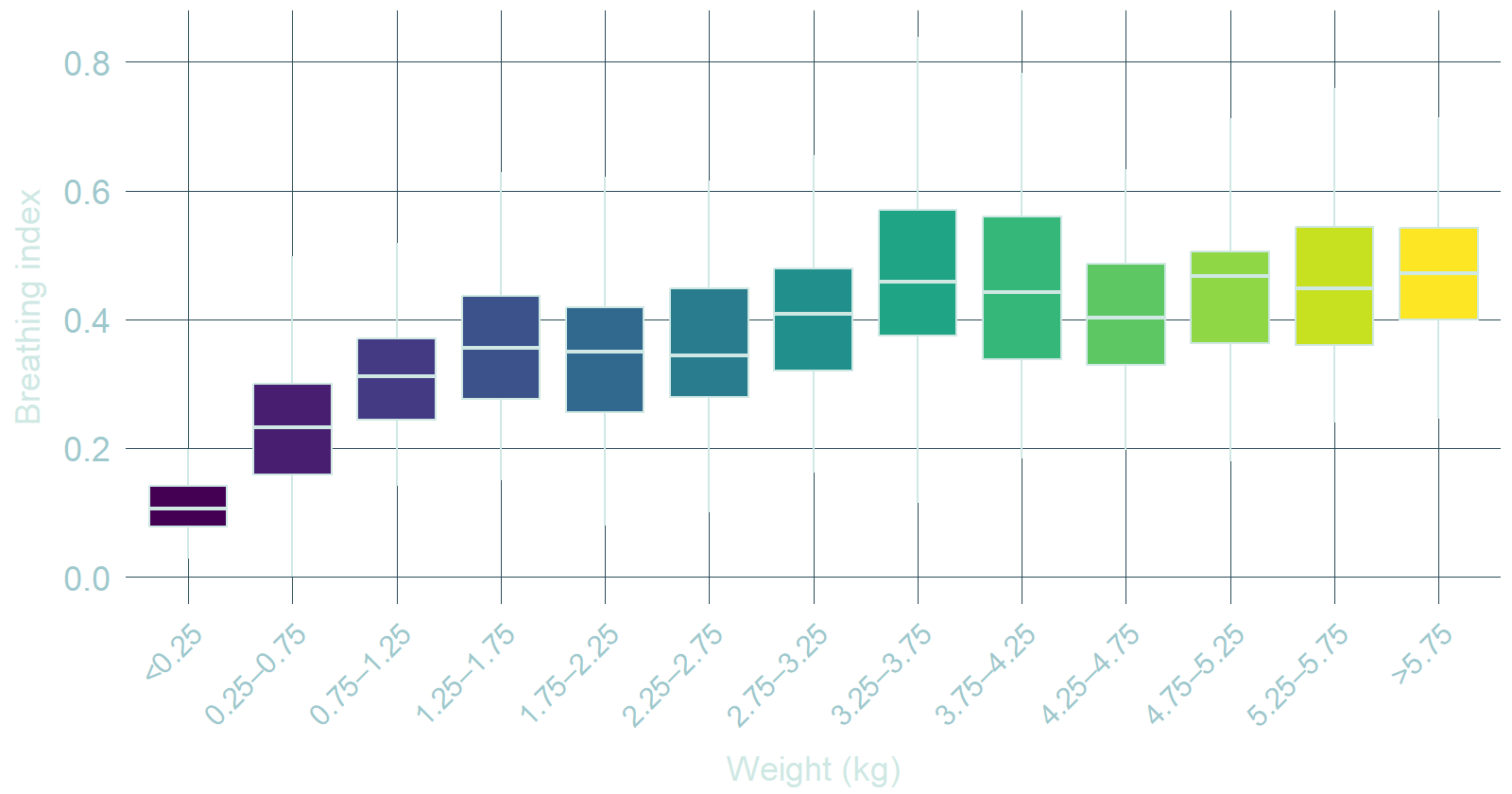
Variation in breathing-index by fish size in commercial marine net pens. For each weight class the table shows: the number of cage days sampled (n), the typical (median) breathing-index value, the normal range, and the level above which a reading is unusually high for that size.
| Weight class (kg) |
n | Typical (median) |
Normal range (25–75%) |
Elevated above (90%) |
|---|---|---|---|---|
| <0.25 | 73 | 0.11 | 0.08–0.14 | 0.20 |
| 0.25–0.75 | 134 | 0.23 | 0.16–0.3 | 0.35 |
| 0.75–1.25 | 78 | 0.31 | 0.24–0.37 | 0.42 |
| 1.25–1.75 | 71 | 0.36 | 0.28–0.44 | 0.52 |
| 1.75–2.25 | 84 | 0.35 | 0.26–0.42 | 0.49 |
| 2.25–2.75 | 101 | 0.34 | 0.28–0.45 | 0.49 |
| 2.75–3.25 | 84 | 0.41 | 0.32–0.48 | 0.55 |
| 3.25–3.75 | 62 | 0.46 | 0.38–0.57 | 0.69 |
| >3.75 | 61 | 0.44 | 0.34–0.56 | 0.70 |
Modulating factors
Body size ▲ Increases index
In larger fish each ventilatory stroke is slower, and the open-mouth phase lasts longer. As a result, even though larger fish breathe less frequently, there mouths are open more often.
Baseline breathing index plateaus beyond ~3.5 kg.
Dissolved oxygen ▼ Decreases index
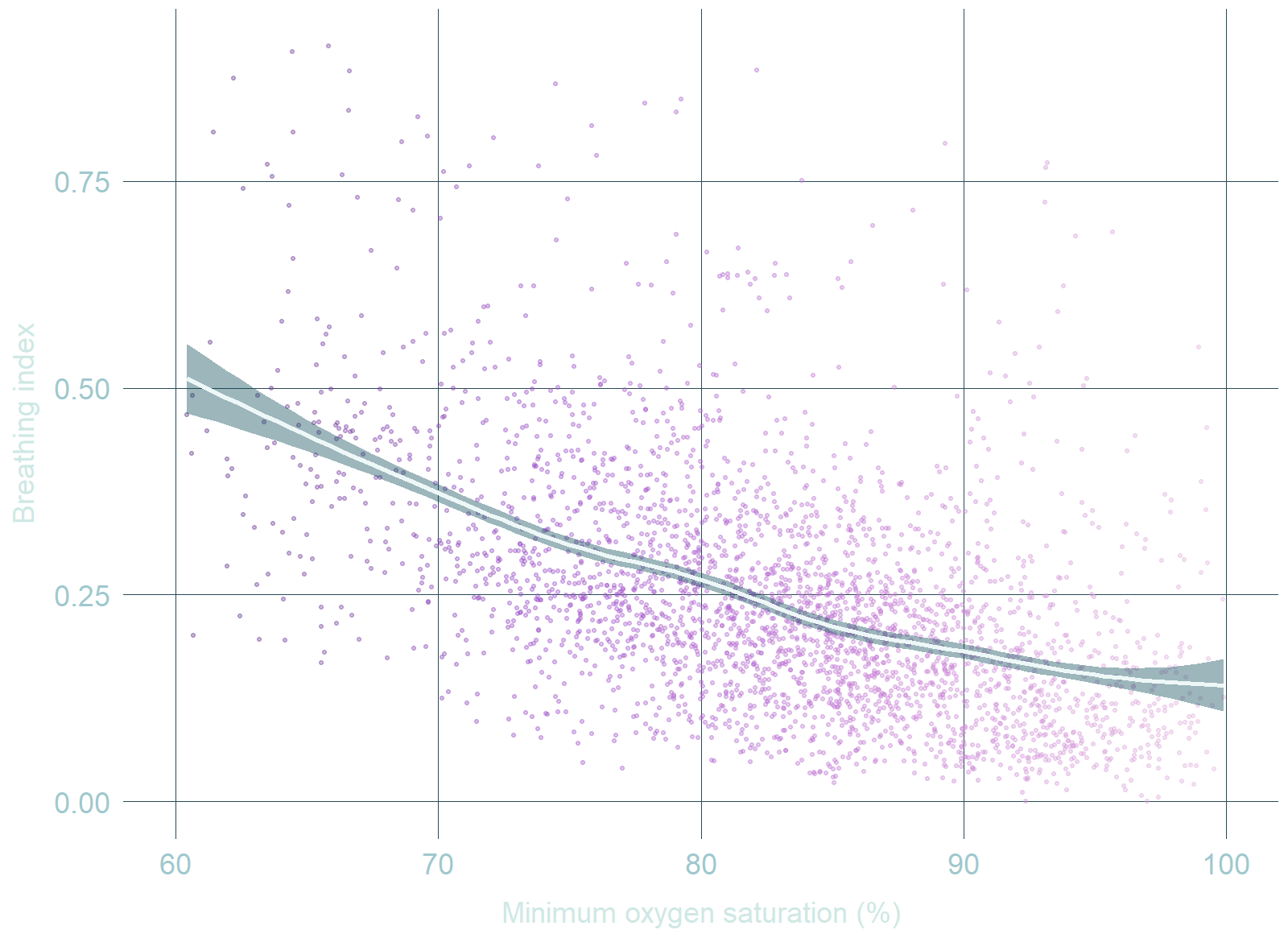
Greater dissolved oxygen availability reduces the need for ventilation across all size classes, approximately halving from 50% to 90% saturation at 10 ˚C. In large fish (4.5 kg), breathing index further decreased when oxygen saturation increased from 90% to 120%.
Salinity ▲ Increases index
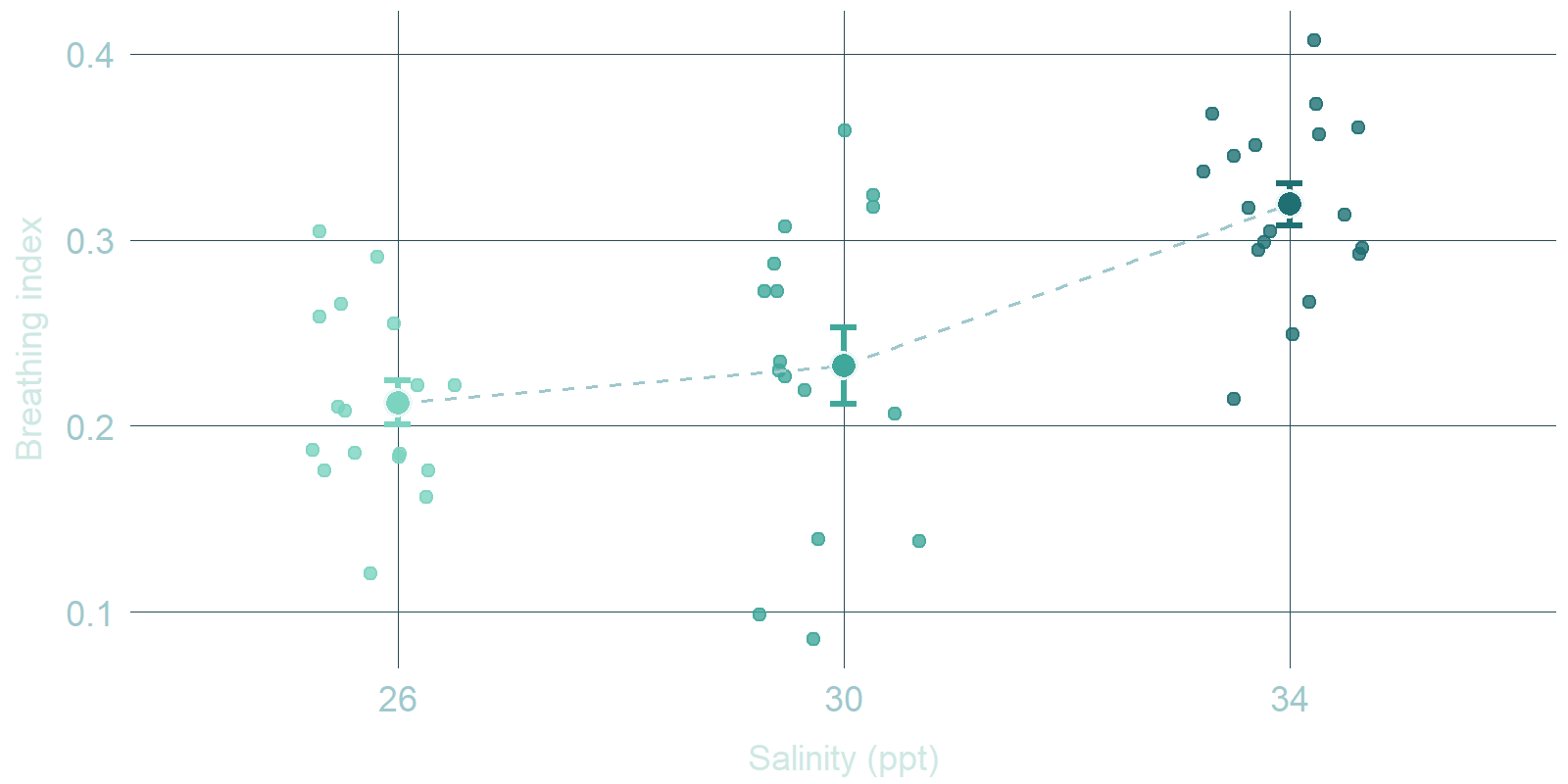
Increased osmotic gradient at higher salinities, increasing the energetic cost of osmoregulation.
Temperature ▲ Increases index
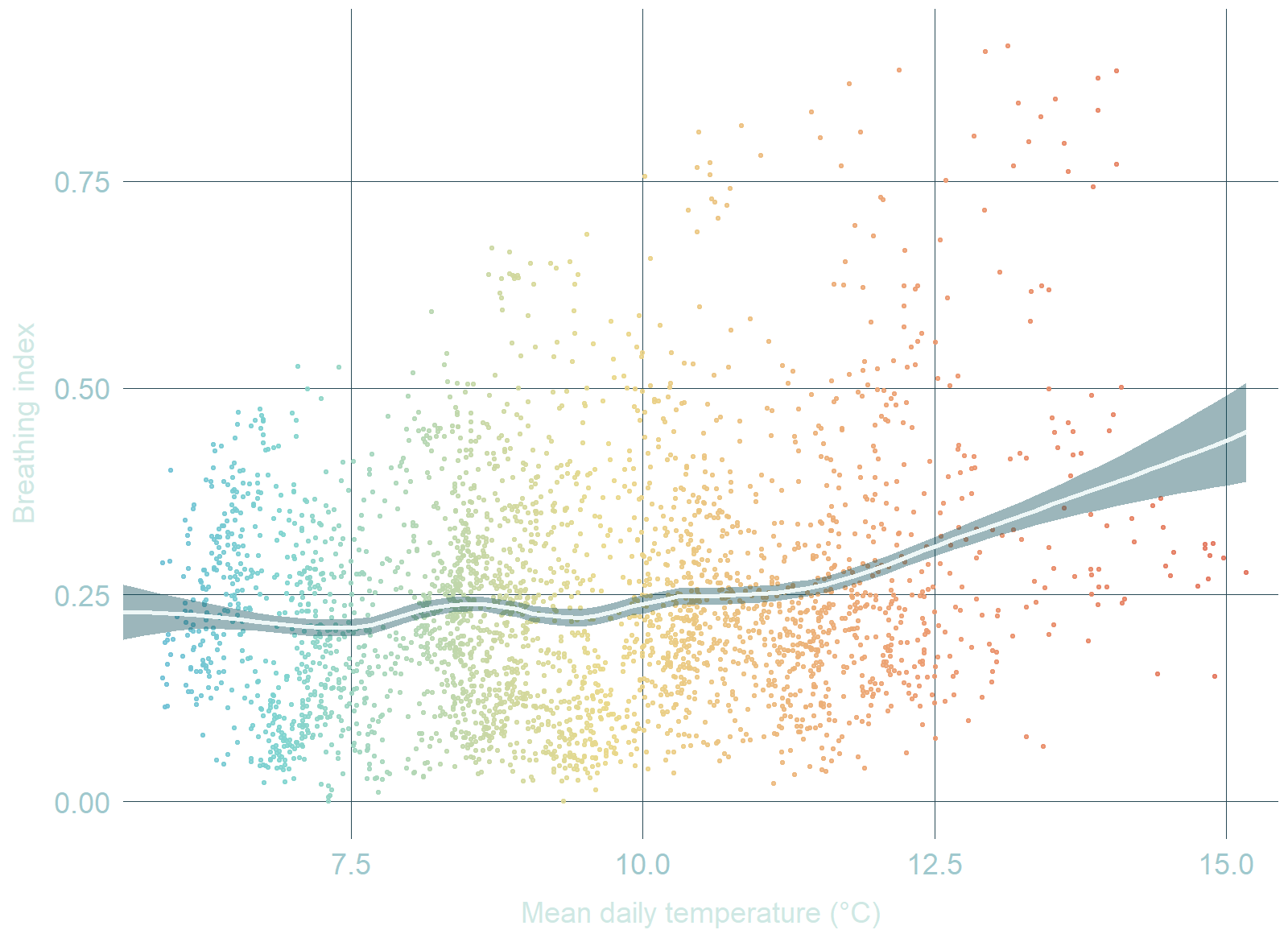
Breathing index is minimally impacted by temperature below 12 °C; above 12 °C increases with increasing temperature.
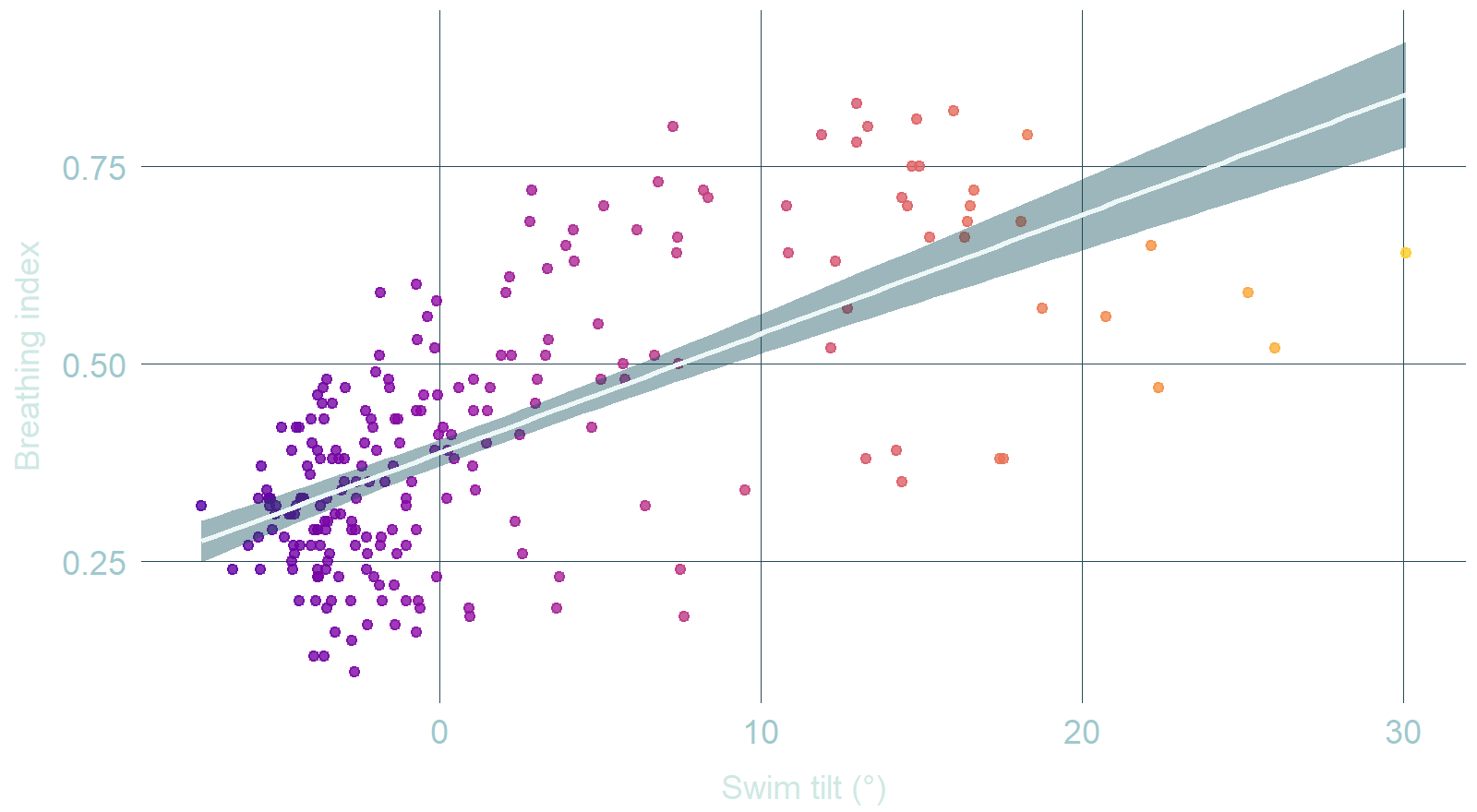
Swim tilt ▲ Increases index
The higher energy expenditure associated with tilted swimming leads to increased respiratory effort.
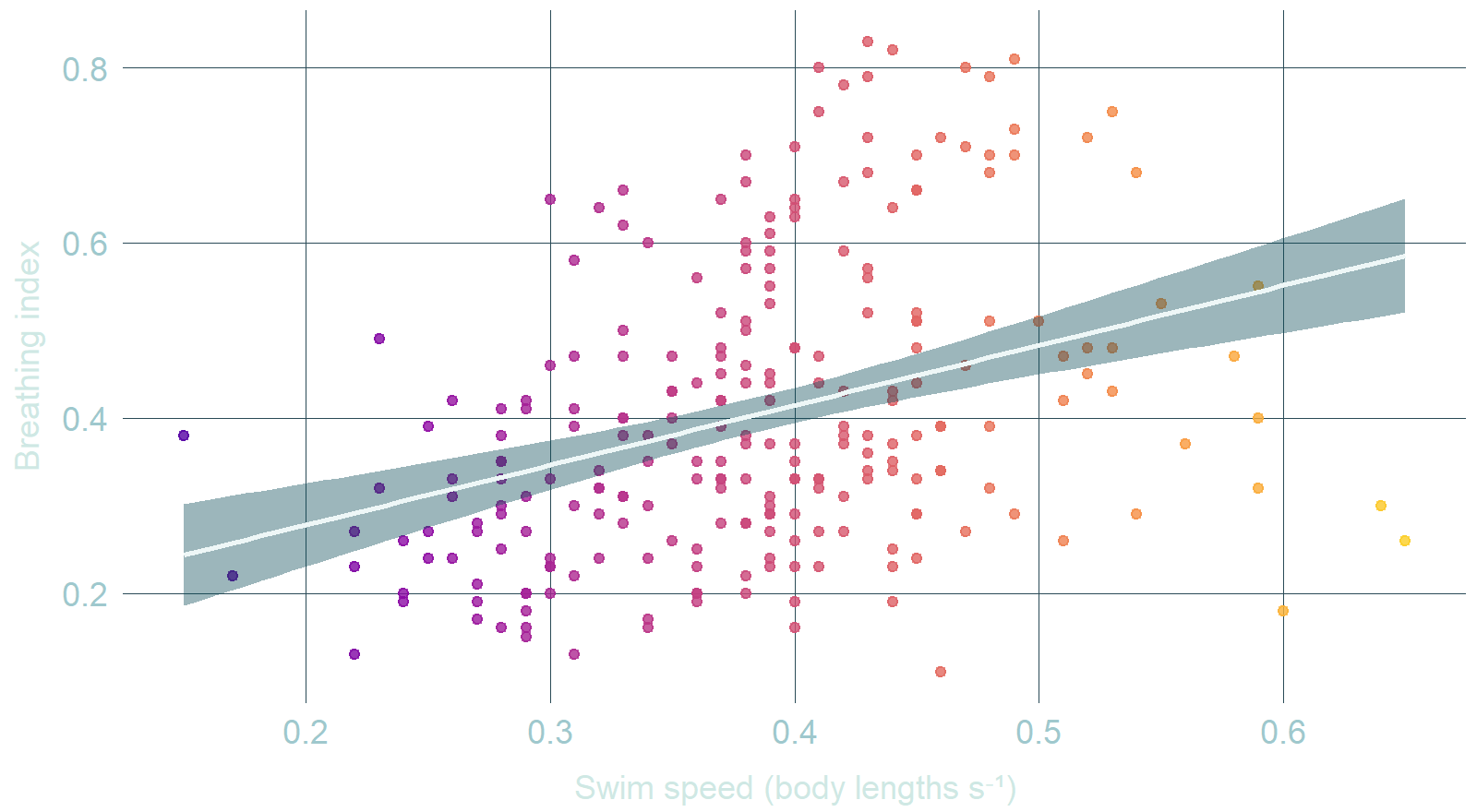
Swim speed ▲ Increases index
Increased respiratory effort with faster swimming.
What remains unknown
- Impact of planktonic threats such as algea blooms or jellyfish on breathing index.
- Impact of compromised health, particularly gill condition, on breathing index.
- How multiple simultaneous stressors interact.
- Size-specific thresholds of impaired welfare.